No pictures today; then again, they would probably only make you hungry. Today was another travel day, this time from Waterloo to Effingham. The day began, more or less, with a homecooked lunch from Andy's mom, and ended (again, more or less) with a cookout with 3/4 of the Stolz family, and ice cream!
By the way, Andy and his mom tie the record for "person I've seen most on this trip." Of my 5 days in Waterloo, I saw Andy on 4 of those days and Mrs. Wolkiewicz on another 4 (Andy had already left for work by the time I woke up this morning). I also saw Yonto and Sarah on four separate days.
Thank you for pretending to care about my made up records.
Showing posts with label Waterloo. Show all posts
Showing posts with label Waterloo. Show all posts
Thursday, June 21, 2007

Wednesday, June 20, 2007
Day 11: St. Louis & Waterloo, IL
On Wednesday, Andy's parents took me to Grant's Farm. Grant's Farm was originally owned by President Grant's father-in-law, then by Grant himself, then by the Busch family. Since then, Anheuser-Busch has turned it into a tourist attraction.
The first place we visited was the grounds where the Clydesdales were kept, raised, and trained.

Sometimes, the horses sleep standing up. I think that's what these next two were doing.


The ponies' legs grow a little faster than the rest of their bodies do, so it's a little awkward for them to get around at times.
One of the qualifications needed to pull the official Budweiser wagon is a black mane and a black tail. From what we could gather, most ponies' tails start out white, and from there they may or may not turn black later on.


This one is stopping for a snack.

Me, bravely defying the "CAUTION, WE MAY BITE!" signs.

After the stables, we took a tram tour around the grounds.
I think there's supposed to be a waterfall back in there.

The original main gates have statues of deer on either side. The deer are fake, but the antlers are real.

Mr. Busch lined the property with gates made out of Civil War rifle barrels, as a memorial to the soldiers in that war. These gates stretch for a couple hundred feet, which is pretty impressive.

This is the original log cabin U. S. Grant built on his in-laws' property.

These covered wagons were sitting outside the log cabin.

As were these cannons.

Some donkeys, just hanging out.

The Grants and Busches both raised and showed horses. This is a very old equestrian jump.

A trumpeter swan, showing off for the tourists by balancing on one leg.

There are supposed to be some Japanese fish in there somewhere.

Rams, I think. Or antelope. I guess my optical zoom isn't all that great.

Baby versions of whatever animals were in the previous picture.

Some longhorns of various types.

Buffalo.

A (relatively) newborn buffalo.

More baby buffalo. Actually, one of them is the same as in the previous shot.

An emu. You'll have to take my word on this one, because it's hard to take pictures as the tram is moving.

A period covered bridge.

See that tree in the middle? Just to the left of it, kind of hidden behind the hill, is an endangered Asian deer. I believe these deer are only found in captivity.

A better look at the same deer.

Ooh, there's an even better look.

The tram dropped us off at this little zoo. I only got a few shots; the first was of these lemurs.

The other was of this bald eagle, looking very truthy. There were two bald eagles; both were rescued after being injured. Neither can fly anymore, so there's no roof or restraints on their area.

Next to the zoo was a carriage house that displayed quite a few old carriages. It also had this bust of Adolphus Busch.

Here's a horse-drawn firetruck, located in the carriage house.

Next to the carriage house was a stable for the show horses. As I mentioned above, the Busches love to show horses. None of these are actually Clydesdales; they were actually a variety of horses in this stable.
Here's Michelob.

Here's a donkey. I'm not sure if it was the "celebrity" donkey that wanted to be a Clydesdale.

Here's the same donkey, after I learned to point my camera lens through the bars, instead of at the bars.

Here's the other donkey that was in the stable. Maybe this is the one from the commercials.

Another show horse.

Here's President Grant's St. Louis home, Whitehaven. It's called Whitehaven because the house was originally white before the Grants discovered lime green paint. The house originally belonged to Grant's father-in-law, and President Grant lived there after the Civil War and before he moved to New York at the end of his life. Oh yeah, there were also eight years in there when he lived somewhere else.

Here's a view of the property from the side. The green house is off to the right. The stone building behind it is the "summer kitchen." In the winter, meals were cooked in the basement (the "winter kitchen"), so the heat from the cooking stoves could spread through the house. In the warmer weather, meals were cooked in a separate building, to keep the heat out of the house. To the left are two red buildings: the icehouse, in which chunks of ice from the adjacent river were stored for up to three years (!) when packed properly, and a chicken coop.

That's it, and unfortunately that's it for the St. Louis area. On Thursday, I stop in Effingham, Illinois to visit the Stolz family.
The first place we visited was the grounds where the Clydesdales were kept, raised, and trained.

Sometimes, the horses sleep standing up. I think that's what these next two were doing.


The ponies' legs grow a little faster than the rest of their bodies do, so it's a little awkward for them to get around at times.
One of the qualifications needed to pull the official Budweiser wagon is a black mane and a black tail. From what we could gather, most ponies' tails start out white, and from there they may or may not turn black later on.


This one is stopping for a snack.

Me, bravely defying the "CAUTION, WE MAY BITE!" signs.

After the stables, we took a tram tour around the grounds.
I think there's supposed to be a waterfall back in there.

The original main gates have statues of deer on either side. The deer are fake, but the antlers are real.

Mr. Busch lined the property with gates made out of Civil War rifle barrels, as a memorial to the soldiers in that war. These gates stretch for a couple hundred feet, which is pretty impressive.

This is the original log cabin U. S. Grant built on his in-laws' property.

These covered wagons were sitting outside the log cabin.

As were these cannons.

Some donkeys, just hanging out.

The Grants and Busches both raised and showed horses. This is a very old equestrian jump.

A trumpeter swan, showing off for the tourists by balancing on one leg.

There are supposed to be some Japanese fish in there somewhere.

Rams, I think. Or antelope. I guess my optical zoom isn't all that great.

Baby versions of whatever animals were in the previous picture.

Some longhorns of various types.

Buffalo.

A (relatively) newborn buffalo.

More baby buffalo. Actually, one of them is the same as in the previous shot.

An emu. You'll have to take my word on this one, because it's hard to take pictures as the tram is moving.

A period covered bridge.

See that tree in the middle? Just to the left of it, kind of hidden behind the hill, is an endangered Asian deer. I believe these deer are only found in captivity.

A better look at the same deer.

Ooh, there's an even better look.

The tram dropped us off at this little zoo. I only got a few shots; the first was of these lemurs.

The other was of this bald eagle, looking very truthy. There were two bald eagles; both were rescued after being injured. Neither can fly anymore, so there's no roof or restraints on their area.

Next to the zoo was a carriage house that displayed quite a few old carriages. It also had this bust of Adolphus Busch.

Here's a horse-drawn firetruck, located in the carriage house.

Next to the carriage house was a stable for the show horses. As I mentioned above, the Busches love to show horses. None of these are actually Clydesdales; they were actually a variety of horses in this stable.
Here's Michelob.

Here's a donkey. I'm not sure if it was the "celebrity" donkey that wanted to be a Clydesdale.

Here's the same donkey, after I learned to point my camera lens through the bars, instead of at the bars.

Here's the other donkey that was in the stable. Maybe this is the one from the commercials.

Another show horse.

Here's President Grant's St. Louis home, Whitehaven. It's called Whitehaven because the house was originally white before the Grants discovered lime green paint. The house originally belonged to Grant's father-in-law, and President Grant lived there after the Civil War and before he moved to New York at the end of his life. Oh yeah, there were also eight years in there when he lived somewhere else.

Here's a view of the property from the side. The green house is off to the right. The stone building behind it is the "summer kitchen." In the winter, meals were cooked in the basement (the "winter kitchen"), so the heat from the cooking stoves could spread through the house. In the warmer weather, meals were cooked in a separate building, to keep the heat out of the house. To the left are two red buildings: the icehouse, in which chunks of ice from the adjacent river were stored for up to three years (!) when packed properly, and a chicken coop.

That's it, and unfortunately that's it for the St. Louis area. On Thursday, I stop in Effingham, Illinois to visit the Stolz family.
Tuesday, June 19, 2007
Day 10: St. Louis & Waterloo, IL
Tuesday was a very busy day, with many pictures. Andy was busy at work again, but his parents were kind enough to take me on a grand tour of St. Louis. Our first stop was for the Anheuser-Busch factory tour.
The first place they took us is the Clydesdale stable. Here's the wagon the Clydesdales pull around.

The dalmations are free to roam around the stable and interact with the people on the tour. This one is a little shy around big groups, though.

This is King. Of course, he looked up at me after I took the picture.

This is the chandelier in the stable. Classy place.
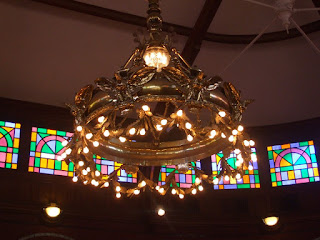
Here's another random chandelier, this one located in the malt room.

Here's a random me, also located in the mash room.

The Malt House, constructed in 1890-something.

The Anheuser-Busch "campus" had very ornate architecture. Here's the clocktower.

These elephants sit next to the gates for one of the buildings. We were told that the elephants represent the bakery yeast that was sold by A-B during Prohibition.

An eagle guards a random sidestreet.

The Brew House. Duh.

The Brew House again, with its Born On Date.
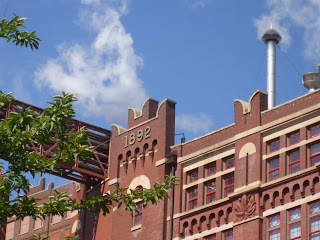
Bevo the Fox. Bevo represents a non-alcoholic drink produced by A-B during Prohibition. This fox-gargoyle is on the Bevo Packaging Plant, a current packaging plant named after the drink.

This sign is on top of the Bevo Plant.

And the inside of the Bevo building's lobby was lined with decorations like this.

These are all the pipes that transport the beer in its various stages from building to building.

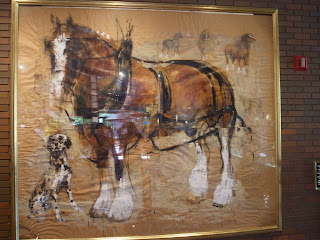
At the end of the tour, there's this painting of a Clydesdale and dalmatian.
Some steins from the owners' personal collections. The larger ones are about 2 feet tall!

This is the outside of the tour center. Why I decided to take this picture last, I don't know.

After the Anheuser-Busch tour, Andy's parents and I headed towards the arch. First we stopped in the St. Louis' old cathedral, which is now a basilica. Sorry, I didn't get any pictures. The old cathedral is in the shadow of the arch. In fact, most of the neighborhood from 1st through 3rd Streets were turned into a park around the arch, but the old cathedral is still there.
I figured a Touchdown Jesus-type shot was only appropriate.

Getting closer to the arch.

Standing right next to the arch, and looking up.

There's a tram that takes you up the arch to an observation deck at the top. (The arch is 630' high, in case anyone was wondering.) I got some decent pictures from there.
Here's the old courthouse, where the Dred Scott decision was made.

Ah, I did get a picture of the old cathedral.


My first attempt at a shot of Busch Stadium.

A "this is how far you can see" shot.

The Jones Center (Arena?). Aerial shots of closed-in arenas aren't too much fun.

No idea what this building is, but it looked nice.

The view out the other side is that of the Mississippi River.
Looking straight down.

A fountain across the river in Illinois.

Another "how far you can see" shot, this time in the direction of Illinois.

A few bridges over the river.

Back over to the St. Louis side, here's a better shot of Busch.

And that's the Millennium Hotel.

The Mississippi side again. A helicopter flew by, and apparently I wanted to create a flipbook.


Back outside, I tried to get a shot standing under the arch, looking straight up. I'm somewhat surprised that there isn't a marker on the ground saying, "This is where the middle of the arch is. Take pictures here."

After the arch, we went to the old courthouse. Now, the courthouse is basically a museum.

This plaque to Joseph Pulitzer is in front of the courthouse steps.

The arch as seen from the courthouse steps.

A shot from the rotunda, looking up into the dome. That's a 33-star flag, from the time of the Dred Scott case. They're commemorating the case's sesquicentennial this year. (Yes, I'm very fired up that I just got to use one of my favorite words, "sesquicentennial.")

Me in one of the courtrooms, trying to look judge-ly. I don't think I pulled it off.

Our final stop in the city was for the Busch Stadium tour. Since it 2 PM on a game day, they started us on the field, just so they could get us off in time for the players to use it. Here's me squinting into the sun.

Here's how the scoreboard looks as seen from the home (first base) dugout. I stood next to the two dugout phones - one for the bullpen, and one to receive calls from the press box when they have questions on injuries and whatnot. I would think that the two phones would be labeled - so the team wouldn't accidentally call up to the press box and ask for the to warm up a lefty - but they're not.

Here's a view of the field from the home radio booth. It's supposed to be the best view in the house.

At the main gate is a statue of Stan The Man Musial. Also in this shot is Stan The Van Honda.

The Royals started BP as we were finishing up our tour.

Here's more BP from a closer point of view.

And here's a second baseman who shouldn't be playing shortstop because of hisweak arm and below-average range. In other words, my hero.

After our tour of St. Louis, Andy's parents and I came back to Waterloo. The city was having its yearly festival celebrating its sister city of Westphalia, Germany. Andy played with Waterloo's municipal band, but I was nice enough not to get a picture of him doing so. I did get a picture of the trombones from the Bud Light Brigade. If you have keen eyes, you may notice that the bones' choice of between-song beverage was not water.

The first place they took us is the Clydesdale stable. Here's the wagon the Clydesdales pull around.

The dalmations are free to roam around the stable and interact with the people on the tour. This one is a little shy around big groups, though.

This is King. Of course, he looked up at me after I took the picture.

This is the chandelier in the stable. Classy place.

Here's another random chandelier, this one located in the malt room.

Here's a random me, also located in the mash room.

The Malt House, constructed in 1890-something.

The Anheuser-Busch "campus" had very ornate architecture. Here's the clocktower.

These elephants sit next to the gates for one of the buildings. We were told that the elephants represent the bakery yeast that was sold by A-B during Prohibition.

An eagle guards a random sidestreet.

The Brew House. Duh.

The Brew House again, with its Born On Date.

Bevo the Fox. Bevo represents a non-alcoholic drink produced by A-B during Prohibition. This fox-gargoyle is on the Bevo Packaging Plant, a current packaging plant named after the drink.

This sign is on top of the Bevo Plant.

And the inside of the Bevo building's lobby was lined with decorations like this.

These are all the pipes that transport the beer in its various stages from building to building.

At the end of the tour, there's this painting of a Clydesdale and dalmatian.

Some steins from the owners' personal collections. The larger ones are about 2 feet tall!

This is the outside of the tour center. Why I decided to take this picture last, I don't know.

After the Anheuser-Busch tour, Andy's parents and I headed towards the arch. First we stopped in the St. Louis' old cathedral, which is now a basilica. Sorry, I didn't get any pictures. The old cathedral is in the shadow of the arch. In fact, most of the neighborhood from 1st through 3rd Streets were turned into a park around the arch, but the old cathedral is still there.
I figured a Touchdown Jesus-type shot was only appropriate.

Getting closer to the arch.

Standing right next to the arch, and looking up.

There's a tram that takes you up the arch to an observation deck at the top. (The arch is 630' high, in case anyone was wondering.) I got some decent pictures from there.
Here's the old courthouse, where the Dred Scott decision was made.

Ah, I did get a picture of the old cathedral.


My first attempt at a shot of Busch Stadium.

A "this is how far you can see" shot.

The Jones Center (Arena?). Aerial shots of closed-in arenas aren't too much fun.

No idea what this building is, but it looked nice.

The view out the other side is that of the Mississippi River.
Looking straight down.

A fountain across the river in Illinois.

Another "how far you can see" shot, this time in the direction of Illinois.

A few bridges over the river.

Back over to the St. Louis side, here's a better shot of Busch.

And that's the Millennium Hotel.

The Mississippi side again. A helicopter flew by, and apparently I wanted to create a flipbook.


Back outside, I tried to get a shot standing under the arch, looking straight up. I'm somewhat surprised that there isn't a marker on the ground saying, "This is where the middle of the arch is. Take pictures here."

After the arch, we went to the old courthouse. Now, the courthouse is basically a museum.

This plaque to Joseph Pulitzer is in front of the courthouse steps.

The arch as seen from the courthouse steps.

A shot from the rotunda, looking up into the dome. That's a 33-star flag, from the time of the Dred Scott case. They're commemorating the case's sesquicentennial this year. (Yes, I'm very fired up that I just got to use one of my favorite words, "sesquicentennial.")

Me in one of the courtrooms, trying to look judge-ly. I don't think I pulled it off.

Our final stop in the city was for the Busch Stadium tour. Since it 2 PM on a game day, they started us on the field, just so they could get us off in time for the players to use it. Here's me squinting into the sun.

Here's how the scoreboard looks as seen from the home (first base) dugout. I stood next to the two dugout phones - one for the bullpen, and one to receive calls from the press box when they have questions on injuries and whatnot. I would think that the two phones would be labeled - so the team wouldn't accidentally call up to the press box and ask for the to warm up a lefty - but they're not.

Here's a view of the field from the home radio booth. It's supposed to be the best view in the house.

At the main gate is a statue of Stan The Man Musial. Also in this shot is Stan The Van Honda.

The Royals started BP as we were finishing up our tour.

Here's more BP from a closer point of view.

And here's a second baseman who shouldn't be playing shortstop because of hisweak arm and below-average range. In other words, my hero.

After our tour of St. Louis, Andy's parents and I came back to Waterloo. The city was having its yearly festival celebrating its sister city of Westphalia, Germany. Andy played with Waterloo's municipal band, but I was nice enough not to get a picture of him doing so. I did get a picture of the trombones from the Bud Light Brigade. If you have keen eyes, you may notice that the bones' choice of between-song beverage was not water.

Subscribe to:
Posts (Atom)
